15 seconds to run into position. No retake. No guarantee. Just trust… and move. Standing here at Daybreak, I realized something— the moment may feel rushed, uncertain, even forced… but the placement is never random. Like Joseph, what once didn’t make sense now feels guided. It was not timing. It was not chance. It was God placing me exactly where I needed to be.
Excerpt Sometimes what feels like a setback is actually God positioning us exactly where we need to be.
Intro There was a time I looked back at a loss in my career and felt the weight of it. It didn’t make sense. It felt like something was taken away.
But looking at Joseph’s story, I see it differently now.
Notes from the Scriptures He sent a man before them, even Joseph, who was sold for a servant. Psalm 105:17
When Joseph revealed himself to his brothers, he acknowledged the devastating decision they had made decades earlier: “I am Joseph your brother, whom ye sold into Egypt.” But he immediately explained how that decision had helped God fulfill his purposes for their family: “Now therefore be not grieved, nor angry with yourselves, that ye sold me hither: for God did send me before you to preserve life” (Genesis 45:4-5). He concluded, “So now it was not you that sent me hither, but God” (Genesis 45:8).
Perspective Joseph stood in front of the very people who caused his suffering—and saw purpose instead of pain.
I’ve had moments where I questioned why something had to happen in my career. At the time, it felt like a loss I didn’t deserve.
But if that door hadn’t closed… I wouldn’t be here.
A full-time opportunity in Utah. A place to rebuild. A place to grow stronger—spiritually, physically, and mentally.
Daily discipline. Clean living. Boxing training that keeps me sharp and grounded. Time to think, to reflect, to reconnect with God.
And the quiet blessings that don’t make noise—but change everything.
Looking back now, I can say with peace:
It was not them. It was God.
Practice (Today, Not Someday) Today, I will trust that not everything that feels like loss is truly loss.
I will move forward with faith, knowing that God may be preparing something I cannot yet see.
Final Reflection Joseph didn’t just survive what happened to him—he understood it.
And when I look at my own path, I see that some of the hardest moments were actually turning points.
God didn’t just fix things later.
He was already there… guiding it from the beginning.
Pocket I’m Keeping What I thought was a setback… was actually a setup.
What I Hear Now “So now it was not you that sent me hither, but God” (Genesis 45:8)
Link to the Talk / Scripture Genesis 45 Psalm 105:17
Intro From the streets of the Philippines to enterprise systems in the United States, my IT journey has been shaped by work, faith, and persistence.
If you are starting from nothing, keep going — progress often begins long before anyone notices.
Early Grit
At twelve years old, I helped support my family by selling newspapers at midnight, shining shoes, washing dishes, and doing whatever work I could find. I didn’t know what IT was back then. I just knew how to work.
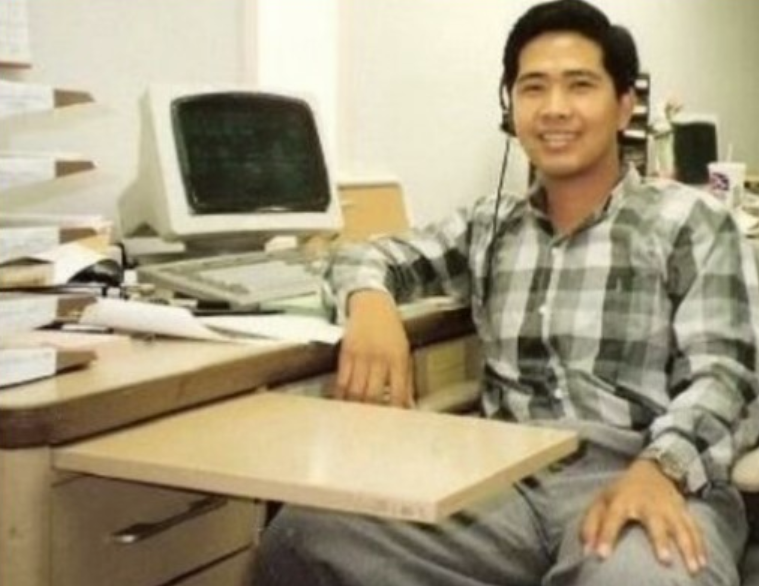
Early 1990s at All Electronics. Long days, multiple bus rides, and the first spark of curiosity about computers.
From Survival to Skill
When I immigrated to the U.S. in 1990, survival came first. I worked warehouse jobs, midnight shifts, and eventually landed a customer service role at All Electronics.
This photo was taken during that time.
From 6:30 in the morning until 3 in the afternoon, I answered calls nonstop — sometimes hundreds in a day. Getting to work meant taking multiple buses across the city. After my shift ended, I took another bus to my second job — either working the drive-through at Taco Bell or selling auto parts at O’Reilly in Reseda.
It was exhausting. But those years built my endurance.
That computer behind me was just part of my job then. I didn’t know it yet, but it would become the doorway to my future.
Later, I bought my own computer and started learning the only way I knew how — by breaking it and fixing it over and over again. Windows 3.0, autoexec.bat, and config.sys became my teachers. Night after night, I stayed with problems until they made sense.
Breakthrough
No one wanted to hire me without experience, so I created my own. I fixed computers for neighbors and small businesses for free. That’s how I learned.
In the early days of IT, skills were learned the hard way. There were no structured learning paths — just curiosity, manuals, broken machines, and persistence.
Eventually, USC took a chance on me — and I made sure I was ready. I supported hundreds of users, worked on migrations, and found my place in IT.
From USC, new doors opened quickly. I was recruited by GTE — now known as Verizon — and not long after, an aerospace company in Carson offered me a six-figure role. It was a moment that reminded me how far persistence can take you.
But in 2003, I made a decision that shaped the rest of my career. I left corporate America and built my own IT consulting company.
The City of West Covina became one of my first major clients — along with firefighters and the police department. USC later brought me back as a senior consultant. Opportunities followed: Microsoft projects, the Claremont Colleges, law firms, American Samoa, and Fortune 500 environments.
Over time, I expanded the business by hiring developers, engineers, and support staff — building not just systems, but people.
Back to Corporate America
The 2008 recession changed everything. It was a time when, as they say, big fish eat small fish. Consulting work slowed, and I knew it was time to pivot again.
My first step back into corporate America was Payforward, a startup company where I helped migrate infrastructure to Amazon Web Services during the early days of cloud adoption. Working in a startup environment sharpened my ability to move fast, solve problems with limited resources, and adapt quickly.
From there, I joined The Church of Jesus Christ of Latter-day Saints as a Support Email Engineer — a worldwide organization operating at global scale. It was there that my PowerShell scripting became more refined and reliable. We supported enterprise messaging systems while the organization expanded into Azure and AWS, strengthening both my automation skills and my understanding of cloud infrastructure.
After that, I moved into the financial sector at City National Bank. That environment introduced me to enterprise-grade infrastructure and security architecture — multiple datacenters, blade server systems, layered “brick-by-brick” firewall protection, application performance monitoring (APM), and the operational discipline required to keep banking systems secure and resilient. It was where infrastructure stopped being just systems and became architecture.
Later, I joined PIMCO (Pacific Investment Management Company), one of the most demanding global environments I had experienced. Technologies like Citrix VDI, AWS, Azure, and enterprise security platforms such as Duo, CyberArk, Arctic Wolf, Palo Alto, and SIEM monitoring were part of daily operations. Mailboxes could reach sizes close to 1 TB, and migrations happened across global regions — North America (NA), Europe, the Middle East, and Africa (EMEA), and Asia-Pacific (APAC).
Like Payforward, these environments required regular PCI-DSS and HITRUST audits. My PowerShell automation matured even further, and I learned how to operate inside highly regulated financial systems where security, compliance, and reliability were non-negotiable.
These experiences prepared me for the infrastructure work I continue to do today.
Where I Am Today
Today I work as an Infrastructure Engineer in Utah. I automate with PowerShell, document systems, support enterprise infrastructure, and mentor others who are starting their own IT journeys.
My work now includes provisioning ERP computers into Intune, managing VMware environments, and maintaining a Cisco Meraki network with a 10GB fiber backbone across MDM and multiple IDF locations. I also support Cisco UCS, Fibre Channel connectivity, Veeam backups, end-of-life transitions, Microsoft Defender, and Azure infrastructure.
Looking back, nothing about this path was easy. But every long bus ride, every second job, and every broken computer taught me something I still use today.
I didn’t fall into IT. I worked my way into it.
Everything I document today in my technical notes traces back to those early days of learning by doing.