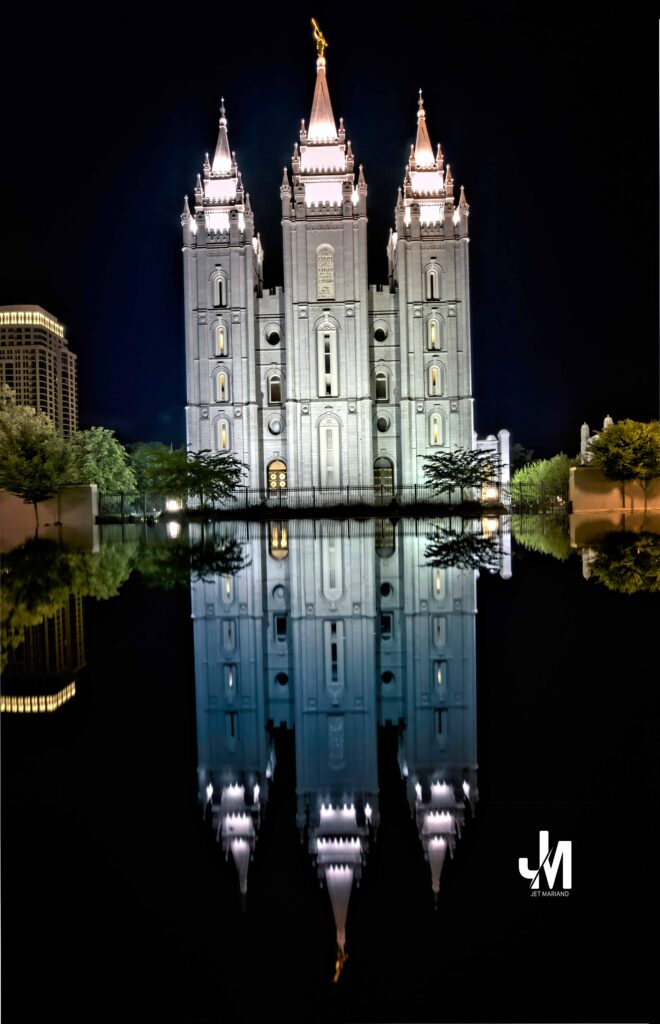
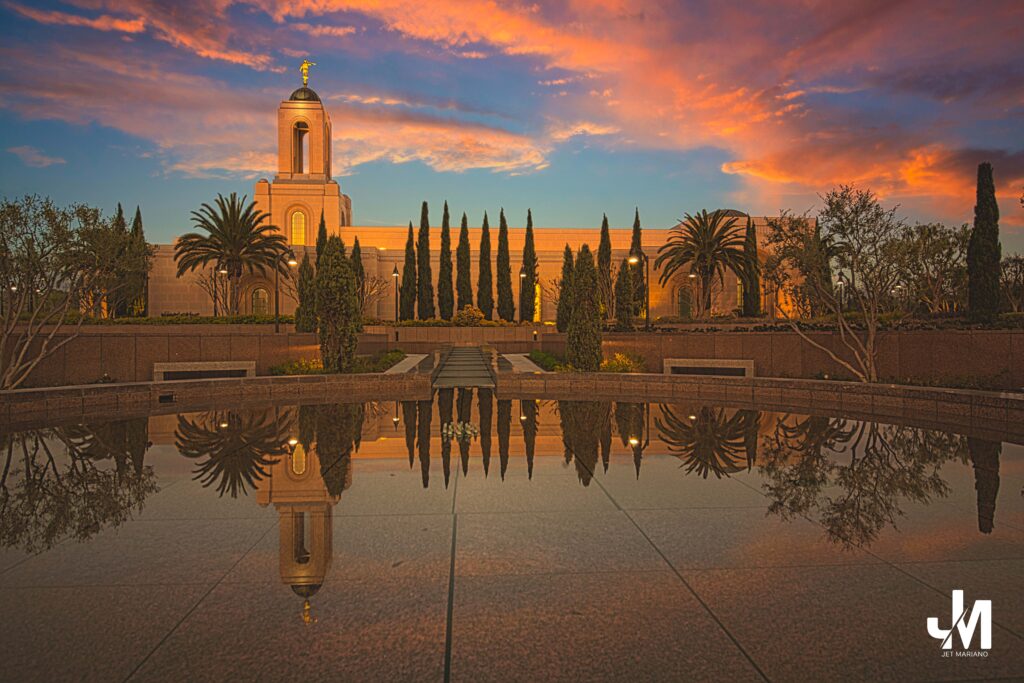
Night photo of the Salt Lake Temple mirrored perfectly in a still reflection pool, symbolizing inner spiritual stillness and a life founded on Christ.
Excerpt Be still—and know.
Intro A journalist walked from a celestial room and whispered, “I didn’t know stillness like that existed.” Elder Bednar invites us past outer quiet into inner spiritual stillness—the kind that fixes our hearts on the Father and the Son, even as life stays loud.
Notes from the Message
“Be still” is more than not moving; it’s remembering and relying on Jesus Christ in all times, things, and places.
Build on the Rock: Christ isn’t merely beneath us; we fasten our foundation to Him. Covenants and ordinances are the anchor pins and steel rods that tie our souls to bedrock.
Sacred time & holy places—Sabbath, temple, and home—train the soul in stillness and covenant focus.
As covenants deepen, virtue garnishes thought, confidence before God grows, the Holy Ghost becomes a constant companion—we become grounded, rooted, established, settled.
Perspective (direct lines & scriptures) “Be still, and know that I am God.” “Remember, remember… build your foundation upon the rock of our Redeemer.” (Helaman 5:12) “Hope… maketh an anchor to the souls of men.” (Ether 12:4)
Practice (today, not someday)
Give God sacred time: one unhurried Sabbath moment, one honest sacrament prayer, one temple appointment on the calendar.
Make home a holy place tonight: turn down the noise, turn up gratitude, read one covenant promise.
Re-anchor: Grounded • Rooted • Established • Settled.
Final Reflection Foundations don’t hold by accident; they hold because they’re tied to the Rock. In a whirlwind world, covenant connection creates interior calm—the stillness where we know and remember: God is our Father; we are His children; Jesus is our Savior. From that stillness, we can do and overcome hard things.
Pocket I’m Keeping Covenants are my anchor pins; Christ is my bedrock.
What I Hear Now Be still—build on Him—do not fall.
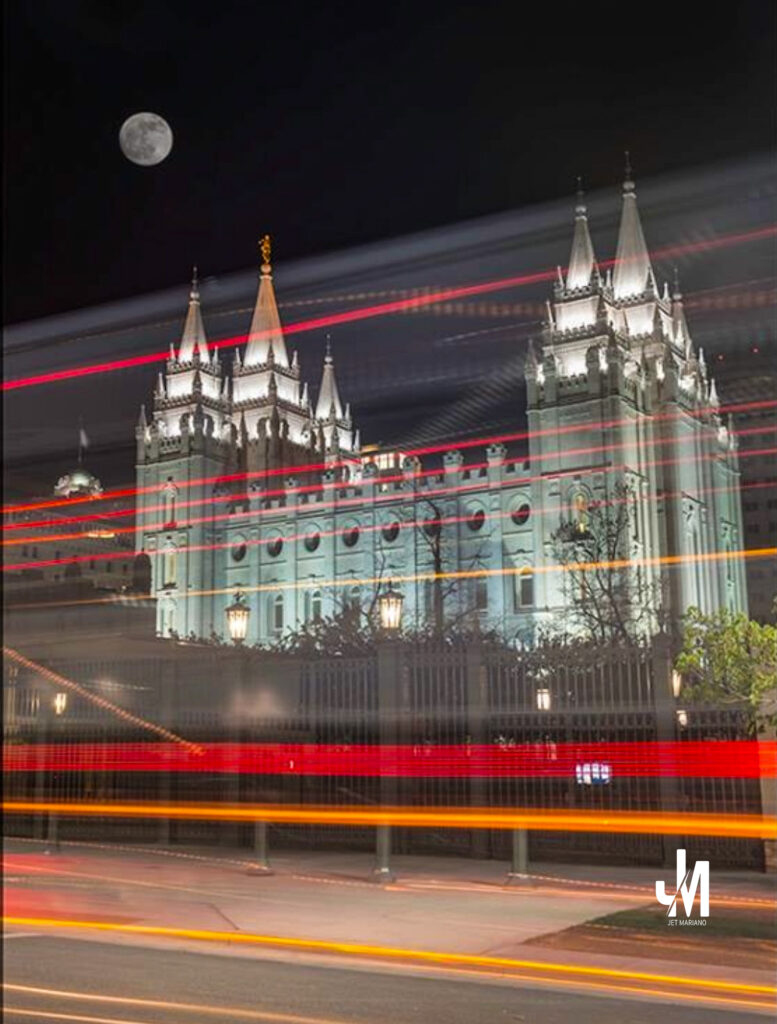
Salt Lake Temple with bus light trails (5 s) and a second exposure for the moon’s detail—the driver was literally playing Don’t Stop Believin’.
Excerpt Headlights, moonlight, and a bus playing “Don’t Stop Believin’.” Intensity 10+.
Intro A passenger bus idled beside me on South Temple. I waited. When it finally pulled out, I opened a long exposure—the lights turned to wide ribbons across the Salt Lake Temple. Then I made a second, short exposure for the moon so its texture wouldn’t blow out. The street soundtrack? Don’t Stop Believin’. Right place, right song, right night.
Notes from the song (what’s good in it)
Hope is a direction, not denial.
Ordinary people + late nights + small steps → real progress.
Community lifts courage; we don’t walk alone.
Grit and wonder can share the same frame.
Perspective (direct quotes) “Streetlight people …” “Searchin’ in the night …”
Practice (today, not someday)
One real step toward the work that matters.
Encourage one person by name.
Re-anchor: Grounded • Rooted • Established • Settled.
Final Reflection Faith feels like this image: long exposure for the road ahead, quick exposure for the guiding light. The temple stands—reinforced at the foundation—and so do I.
Pocket I’m Keeping Between streetlights, keep moving.
What I Hear Now (direct quote) “Don’t stop believin’.”
Jordan River Utah Temple — Rain on Glass. iPhone shot from the driver’s seat; focus on the droplets to let the temple bloom softly behind. Light edit for contrast/clarity on the foreground drops.
Excerpt When life is heavy, rest isn’t escape—it’s yoking with Christ and keeping covenants. Even through rain-blurred glass, the temple holds steady.
Intro After sacrament it poured. I drove to the Jordan River Temple and stayed in the car, letting the storm drum on the windshield. Through a thousand raindrops, the spire stayed true. That quiet minute was my rest.
Perspective (direct quotes)
“Come unto me… and I will give you rest. … My yoke is easy.” (Matthew 11:28–30)
“Be of good cheer; I have overcome the world.” (John 16:33)
President Russell M. Nelson: Covenant keepers have increased access to the power of Jesus Christ and are entitled to a special kind of rest through their covenant relationship with God.
Principles
Rest comes with the yoke, not from running away.
The covenant path stays visible—even when everything else is blurry.
Small, steady acts (prayer, sacrament, ministering, temple) invite power and peace.
Practice (today, not someday)
Name one burden and yoke it to Christ in prayer.
Keep one covenant action (text a ministering message, schedule a temple visit).
Trade one distraction for five minutes of stillness with the scriptures.
Pocket I’m Keeping Covenants > chaos. I can rest while it rains.
What I Hear Now “Walk with Me.” • “Let the temple teach you to rise.”
When the upgrade sits at 99%… don’t panic. Go offline and run the ISO upgrade the smart way
Windows 10 reaches end of life on Oct 5, 2025. After that, it won’t get security updates. If you stay on Win10, your machine is a sitting duck for malware and attackers. Don’t procrastinate.
If Windows Update keeps failing—or hangs forever at 99%—use this clean, offline upgrade that skips the flaky “checking for updates” step.
Important: The most common blockers are the CPU and motherboard (TPM 2.0, UEFI/Secure Boot). If your device doesn’t meet Windows 11 requirements, it’s unsupported after Oct 5, 2025. Treat that Windows 10 PC as unsafe for internet use—either upgrade/replace the hardware, reassign it to offline tasks, or retire it.
2) Prep (5–10 minutes)
Unplug non-essential USB devices (drives, printers, docks).
Ensure ≥30 GB free on C:.
Suspend BitLocker (if enabled): Control Panel → BitLocker → Suspend.
We saw spoofed messages and rogue auto-forward rules spreading from a few mailboxes. Root cause looked like mailbox rules + legacy SMTP AUTH exposure, not a server breach.
What we did (playbook)
Containment (no downtime): remove mailbox forwarding, delete suspicious inbox rules, and disable SMTP AUTH per mailbox (modern Outlook/OWA unaffected).
Tenant guardrail: block external auto-forward on the default remote domain.
Salt Lake Temple, sunset from the JSB window. Waiting for the flare taught me: contention is toxic—anger never persuades; hostility builds no one. Be a peacemaker.
BTS (behind the shot): From the Joseph Smith Building, shooting through the window glass with my trusty 14–24mm f/2.8 at 14mm. I bracketed exposures and waited for the sun to flare behind Moroni without losing the cloud detail. Patience, angle, and a clean pane made the rays sing.
Excerpt
When words run hot, the Spirit runs quiet. President Russell M. Nelson’s call—“Peacemakers Needed”—reminds me that covenant disciples build and bless, even under fire. Today I’m choosing to cool my speech, lift my neighbors, and let charity do the heavy lifting.
Intro
The world feels loud. But on the temple roofline tonight, light broke through and stitched the sky together. President Nelson’s sermon lands the same way: direct, steady, hopeful. Peacemakers aren’t passive; they’re disciplined disciples who speak higher and holier. This post is my small practice at that.
Notes from President Nelson (Sep 2023)
Contention is toxic and common—even at home. “Anger never persuades. Hostility builds no one. Contention never leads to inspired solutions. Regrettably, we sometimes see contentious behavior even within our own ranks… spouses and children belittled, angry outbursts used to control, ‘silent treatment,’ youth who bully, and employees who defame colleagues.”
Contention is evil. “Make no mistake about it: contention is evil! Jesus Christ declared that those who have ‘the spirit of contention’ are not of Him but are ‘of the devil’… Those who foster contention are taking a page out of Satan’s playbook.”
What people really need from us. “If a couple in your ward gets divorced… a missionary returns early… a teenager doubts his testimony—they do not need your judgment. They need to experience the pure love of Jesus Christ in your words and actions.” “If a friend on social media has strong views that violate everything you believe in, an angry, cutting retort will not help. Build bridges of understanding.”
Peacemaking is a covenant choice. We can choose contention or reconciliation; charity is the antidote and the temple empowers us to cast the adversary out of our relationships.
Our standard of speech: If anything is “virtuous, lovely, of good report, or praiseworthy,” say that—to faces and behind backs.
Perspective
Peacemaking isn’t “peace at any price.” It’s covenant keeping with our mouths, our posts, and our reactions. The temple in view—Salt Lake—reminds me: God gathers, builds, and refines. If I’m with Him, my words should too.
Practice (today, not someday)
Pause before post. If it won’t lift, it won’t live on my feed.
Bridge the gap. Ask one sincere question where I disagree.
Name the good. Offer one specific, praiseworthy sentence to someone who needs it.
Close the loop. Repair one relationship where my words cooled the room.
Final Reflection
Light rays don’t fight the clouds—they pass through and transform them. Peacemakers do the same with hard moments. Charity takes the sharpness out of sentences and puts strength back into souls.
Pocket I’m Keeping (one-liner)
“Charity is the antidote to contention.”
What I Hear Now (direct quotes from President Nelson)
“Anger never persuades. Hostility builds no one. Contention never leads to inspired solutions.”
“Contention is a choice. Peacemaking is a choice.”
“Make no mistake about it: contention is evil!”
“If there is anything virtuous, lovely, of good report, or praiseworthy we can say about another… that should be our standard of communication.”
“Now is the time to bury your weapons of war. The pure love of Christ is the answer to the contention that ails us today.”
Oakland California Temple — Night at the Fountain. I camped here for hours, waiting for the Bay’s rolling fog to clear so I could include the stars. Long exposure smoothed the water and lifted the temple’s glow. Patience + small adjustments = a better, truer image. Same with repentance.
Behind the Scene (BTS) I camped at the temple for hours, waiting out the Bay Area’s rolling fog for a clear sky to include the stars. Patience paid off—and reminded me: I can do better and be better.
Intro President Nelson’s message, “We Can Do Better and Be Better,” hits me in the best way—direct, hopeful, and actionable. Repentance isn’t a rare event; it’s a daily rhythm that unlocks strength, purity, and joy. Watching the fog clear over the temple, I felt the same invitation: step forward, again, today.
Notes from President Nelson • Repentance is a process, not a punishment; it is “the key to happiness and peace of mind.” • When we choose to repent, we choose to change—to become more like Jesus Christ. • Daily repentance is the pathway to purity, and purity brings power (priesthood power is tied to heaven’s power). • The adversary is intensifying; we cannot be spiritually asleep. Put on the whole armor of God and get to work. • Honor your covenants, your body, and the women in your life—put people above screens and distractions. • The Lord needs selfless, covenant-keeping disciples who hear the Spirit clearly and act with integrity.
Perspective Repentance is the Lord’s way of lifting, not shaming. A little better each day is heaven’s pace. Stars eventually break through the fog; so does grace when we keep showing up.
Practice (today, not someday) • Do a 10-minute inventory tonight: What should I stop, start, or continue so I can repent daily? Write one sentence and act on it before bed. • Honor a body choice: sleep, food, movement, or media—pick one thing and treat your body like a temple today. • Put people first: one undistracted conversation (no screens). • Covenant check-in: pray specifically for help to keep one covenant better tomorrow than today.
Final Reflection The temple stands steady while water moves and stars emerge—that’s what repentance does for a soul. It anchors us while the Lord reshapes us. “Doing better and being better” isn’t grand theater; it’s small, faithful, repeatable steps that invite power from heaven.
Pocket I’m Keeping “Daily repentance is the pathway to purity, and purity brings power.”
What I Hear Now (direct quotes from President Nelson)
“Brethren, we all need to repent. We need to get up off the couch, put down the remote, and wake up from our spiritual slumber.”
“The Lord needs selfless men who put the welfare of others ahead of their own. He needs men who intentionally work to hear the voice of the Spirit with clarity. He needs men of the covenant who keep their covenants with integrity.”
“I bless you to do better and be better. And I bless you that as you make these efforts, you will experience miracles in your life.”
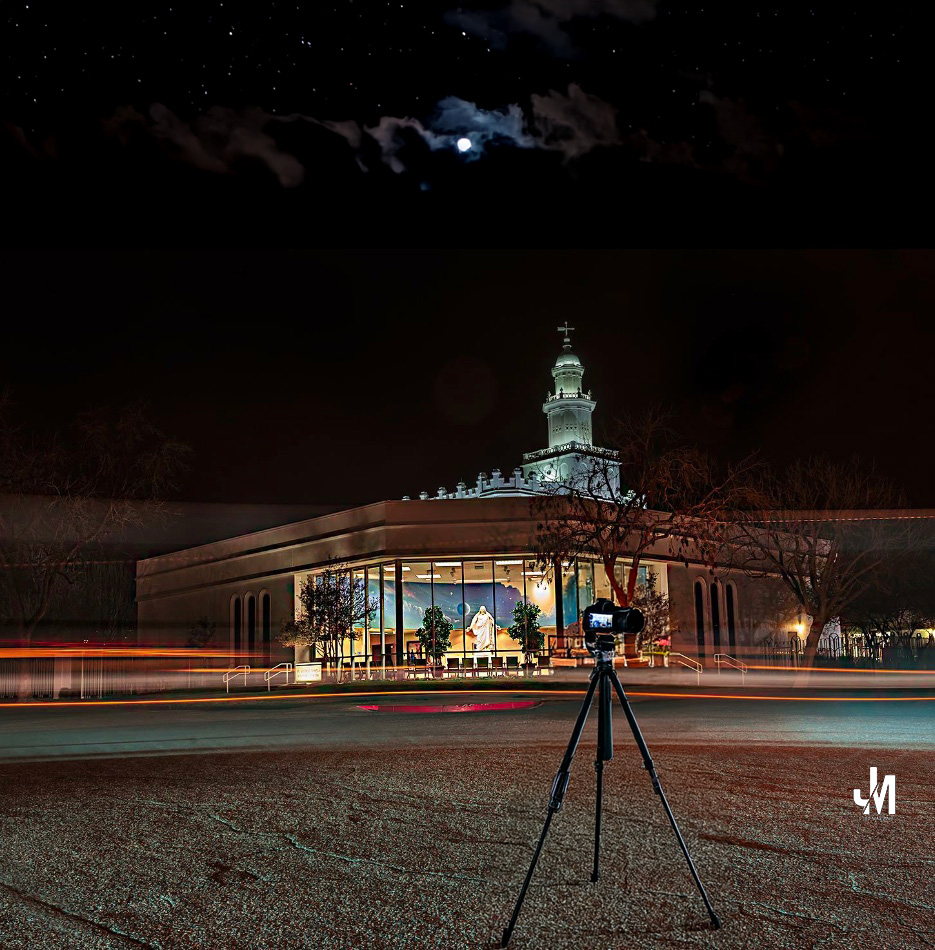
St. George Utah Temple — staged long-exposure. I set the camera on a tripod, framed the composition, and patiently waited for a car to pass and paint light across the scene while the moon peeked through the clouds. Momentum takes patience—and a steady heart.
Excerpt
Small, steady choices create spiritual momentum. Tonight I staged the scene—one camera locked down for a 20-second exposure while I waited for a car to drive slowly and paint light across the temple. Planned movement, steady heart.
When life feels hot and hurried, deep roots matter. President Russell M. Nelson shows us how to build momentum that lasts—covenant by covenant, day by day.
Intro
Momentum changes games—and lives. President Nelson compared it to a team that grabbed two quick baskets before halftime and never looked back. “Momentum is a powerful concept.” In discipleship, positive spiritual momentum keeps us moving when heat, headlines, or hard days try to slow us down. And while “none of us can control nations or the actions of others or even members of our own families,”we can control ourselves. His five invitations—small, steady choices—gather power:
Get on the covenant path (and stay).
Discover the joy of daily repentance.
Learn about God and how He works.
Seek and expect miracles.
End conflict in your personal life.
Notes from President Nelson (Sep 2022)
“With all the pleadings of my heart, I urge you to get on the covenant path and stay there.”
“Ordinances and covenants give us access to godly power. The covenant path is the only path that leads to exaltation and eternal life.”
“Please do not fear or delay repenting. Satan delights in your misery. Cut it short. Cast his influence out of your life! Start today to experience the joy of putting off the natural man.”
Daily worship/study nourishes testimony; without it, faith can crumble “with frightening speed.”
“God has not ceased to be a God of miracles.” Do the spiritual work and believe, “doubting nothing.”
“I plead with you to do all you can to end personal conflicts that are currently raging in your hearts and in your lives.”
Promise: acting on these brings increased momentum, strength to resist, more peace of mind, freedom from fear, and greater family unity.
Perspective
Covenant power is real. Baptism, sacrament, and temple covenants plug us into godly power.
Repentance is progress, not punishment. “Please do not fear or delay repenting… Cut it short… Start today…”
The climb is designed to change us. “Now, a caution: Returning to the covenant path does not mean that life will be easy. This path is rigorous and at times will feel like a steep climb. This ascent, however, is designed to test and teach us, refine our natures, and help us to become saints. It is the only path that leads to exaltation.”
Peacemaking is discipleship. Ending conflict invites the Prince of Peace into the room.
Miracles may take time and may not match our first request—but the Lord moves the mountain in His way, in His time.
Practice (today, not someday)
Pick one small action to spark momentum today:
Schedule the temple (or step toward worthiness with your bishop).
Write one concrete repentance step; do it before bed.
Give God 10 undistracted minutes—scripture + prayer.
Ask for one needed miracle and the faith to act.
Make peace with one person (forgive or seek forgiveness).
Final Reflection
My staged photo worked because the camera stayed still while the light moved. Discipleship is the same: a heart fixed on covenants lets grace “paint” our lives with motion and light. Small, holy repetitions—repent, learn, believe, reconcile—create a current that carries us when our own strength fades.
Pocket I’m Keeping
“Walking the covenant path, coupled with daily repentance, fuels positive spiritual momentum.” That’s my pocket sentence for the week.
What I Hear Now
Keep the camera steady—covenant steady. Let Me provide the light and the timing. Do the small things today; I’ll handle the mountains.
Link to the talk
President Russell M. Nelson, “The Power of Spiritual Momentum.” (General Conference)
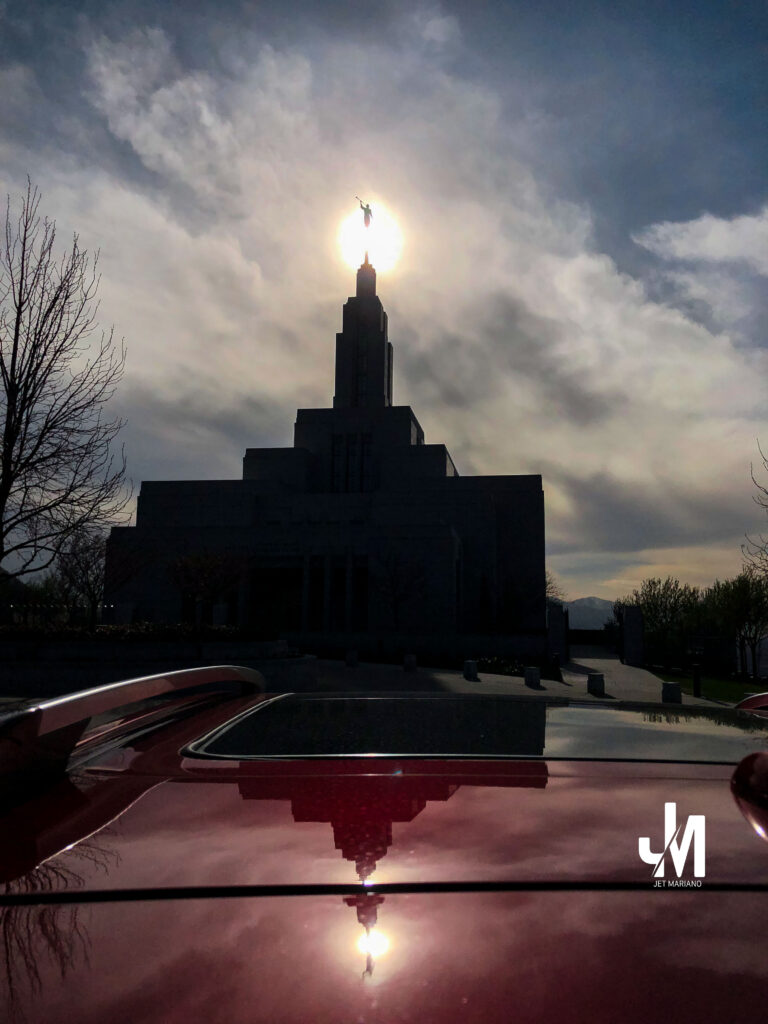
Sun crowns the Angel Moroni and echoes in the red-car reflection—heaven above, witness below. Today I’m choosing to be “grounded, rooted, established, and settled.” Elder Neal A. Maxwell’s devotional was given 44 years ago today (Sept 15, 1981); I’ve listened to and reread it more than forty times since last night, and it still steadies me. Behind the shot (BTS) iPhone only. I walked the grounds, lining up angles until the sun sat directly behind Moroni. I waited for the clouds to thin, then chose the red car as my foreground to mirror the spire and add a second “sun.” Composing a photograph isn’t easy—it takes patience, timing, and a little inspiration.
Excerpt When life feels hot and hurried, deep roots matter. Elder Neal A. Maxwell taught us to become “grounded, rooted, established, and settled.” Today I’m practicing that—quietly, covenant by covenant—so the sun doesn’t scorch my faith.
Intro What a coincidence—September 15. On this date in 1981, Elder Neal A. Maxwell delivered a devotional that feels tailor-made for our moment. He urged a discipleship with depth, the kind that survives heat and headlines: grounded, rooted, established, and settled. He reminded us that God’s curriculum is deliberate—patience, meekness, love, self-discipline—and that routine isn’t pedestrian; it’s providential. Real growth happens “in process of time” and “according to the flesh”—ordinary days doing eternal work. If the world’s scaffolding falls away, what stands? Holy ground and holy habits. I want those roots.
Straight line • Deep roots > fast leaves (Colossians 2:6–7). • After we’ve “suffered a while,” grace “stablish[es], strengthen[s], settle[s]” (1 Peter 5:10). • The seed survives the sun when nourished “with great diligence, and with patience” (Alma 32). • Ordinary days are eternal classrooms; portable skills—meekness, charity, self-discipline—rise with us.
Notes from Elder Maxwell (Sep 15, 1981) • Growth without roots scorches. Disciples withstand heat because they are grounded—not trending. • Scaffolding and applause fall away; covenant habits remain. • God’s curriculum forms eternal, portable skills we’ll need forever. • Routine can be resplendent: quiet covenant keeping outlasts headlines. • Keep gospel perspective: our basic circumstances are strikingly similar—we are God’s children, accountable, loved, and capable of steady growth.
Perspective (directly from the devotional) “A hundred years from now, today’s seeming deprivations and tribulations will not matter then unless we let them matter too much now. A hundred years from now, today’s serious physical ailment will be but a fleeting memory.”
“A thousand years from now, those who now worry and are anguished because they are unmarried will, if they are faithful, have smiles of satisfaction on their faces in the midst of a vast convocation of their posterity. The seeming deprivation which occurs in the life of a single woman who feels she has no prospects of marriage and motherhood properly endured is but a delayed blessing, the readying of a reservoir into which a generous God will pour all that he hath. Indeed, it will be the Malachi measure: ‘there shall not be room enough to receive it’ (Malachi 3:10).”
Practice (today, not someday) • Choose one root to deepen: scripture before screens; prayer with listening; sacrament with intent. • Trade hurry for holy: slow the reply, soften the tone, serve someone nearby. • Write one “settled” choice: the commandment I will keep even when the sun is hot. • Plant a small habit that outlasts headlines: five minutes of gratitude, one quiet act of mercy, one bridge-building conversation.
Final reflection I can’t cool the world’s weather, but I can deepen my roots. If I will be grounded in Christ, the same sun that scorches shallow soil will ripen real fruit. Ordinary days, kept with covenants, become the very ground where God “stablishes, strengthens, and settles” the soul.
Pocket I’m keeping • Deep roots before bright leaves. • Perspective over panic. • Ordinary days are eternal classrooms. • Meekness travels well—now and forever.
What I hear now “Rooted and built up in him, and stablished in the faith” (Colossians 2:7). “After that ye have suffered a while… stablish, strengthen, settle you” (1 Peter 5:10). “Nourished by your faith with great diligence, and with patience” (Alma 32:41).
I waited for silence—no wind, no fountain—then the temple doubled in the pond. “The enmity of all flesh shall cease” (D&C 101:26). BTS:[x trips], [y minutes/hours] of watching the surface until the last ripple disappeared.
Intro News this week was hard to take. A familiar U2 refrain kept circling my mind—“How long?” When the world feels loud and unsteady, I go back to the Lord’s promises. In 1833, as Saints were driven from their homes in Missouri, the Savior described what His return will bring (see Doctrine and Covenants 101:23–34): we will see Him together; all things will become new; the enmity of all flesh will cease; Satan will lose his hold; sorrow will yield to life; and truth will be revealed in full. That is not wishful thinking—it’s a covenant future.
Straight line
Begin living heaven’s law now. When the Savior appeared in the Americas, He warned plainly: “He that hath the spirit of contention is not of me” (3 Nephi 11:29).
It really can happen. After His ministry, the record reports: “There was no contention among all the people” for many years (4 Nephi 1:13).
Zion prepares the way. Elder D. Todd Christofferson taught that the Lord will return to a people prepared to receive Him—Zion: “of one heart and one mind,” righteous, with “no poor among them” (April 2019, Preparing for the Lord’s Return).
Preparation looks practical. Lower our voices. Lift burdens. Trade hot takes for holy listening. Replace talking points with personal service.
Practice the peace you’re praying for. The future promise is sure; the daily choice is mine.
Final reflection I can’t rush His timetable, but I can reduce contention in my sphere. If I want a world where enmity ends, I can start with my words, my replies, my assumptions—and my willingness to build bridges where the world builds walls.
Pocket I’m keeping
Live heaven’s law now.
No contention—beginning with me.
Zion = one heart, one mind, no poor.
Practice peace: listen, serve, reconcile.
Hope is a covenant, not a mood.
What I hear now “The enmity of man, and the enmity of beasts … yea, the enmity of all flesh, shall cease” (D&C 101:26).
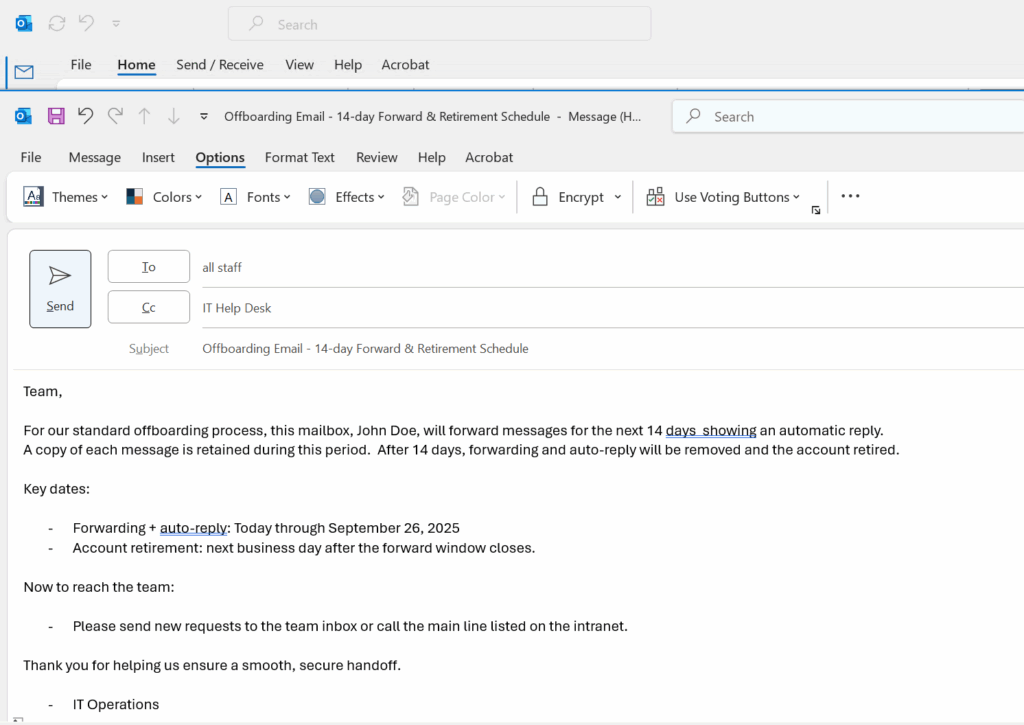
Clean handoff: 14-day forward then retired the mailbox. using powershell
Excerpt
A simple, low-risk offboarding pattern: enable a 14-day forward to the supervisor with an auto-reply, keep copies in the mailbox, then remove forwarding and retire the account. No shared mailboxes, no drama.
Photo suggestion
Something neutral and professional: a close-up of a keyboard lock icon, or a soft sunset over a temple (if you want to keep the page’s visual theme). Caption idea: “Quiet handoffs, clean closures.”
Context (redacted)
Policy: No shared mailbox conversions. For leavers, enable a 2-week mail forward to the supervisor, show a clear auto-reply, then delete the user so the mailbox soft-deletes and later hard-deletes. Team files live in SharePoint/Teams; local working data is archived to encrypted USB for short-term retention.
Before (T0) — Enable 14-Day Forward + Auto-Reply
Goal: Forward new messages for two weeks and keep a copy in the mailbox for audit/review; clearly inform senders.
# Admin sign-in
Import-Module ExchangeOnlineManagement -ErrorAction SilentlyContinue
Connect-ExchangeOnline

# Vars
$User       = "[email protected]"
$Supervisor = "[email protected]"
$Days       = 14
$Now        = Get-Date
$End        = $Now.AddDays($Days)

# Enable mailbox-level forwarding (keep a copy)
Set-Mailbox -Identity $User `
  -ForwardingSmtpAddress $Supervisor `
  -DeliverToMailboxAndForward $true

# Schedule auto-replies for the same window
$InternalMsg = @"
This mailbox is no longer monitored.
For assistance, please contact $Supervisor or call the main line.
"@

$ExternalMsg = @"
Thanks for your message. This mailbox is no longer monitored.
Please email $Supervisor for assistance.
"@

Set-MailboxAutoReplyConfiguration -Identity $User `
  -AutoReplyState Scheduled `
  -StartTime $Now `
  -EndTime $End `
  -InternalMessage $InternalMsg `
  -ExternalMessage $ExternalMsg `
  -ExternalAudience All
Parallel housekeeping (same day):
Reset the user’s password, revoke sign-in sessions, and (optionally) block sign-in during the transition.
Transfer/confirm ownership of OneDrive/SharePoint/Teams files needed by the team.
Archive any local workstation data to an encrypted USB (BitLocker To Go) if policy allows.
After (T+14) — Remove Forwarding → Retire Account
Goal: Stop forwarding, disable auto-reply, and delete the user (soft-delete mailbox). Optionally hard-delete the mailbox once soft-delete is visible.
Import-Module ExchangeOnlineManagement -ErrorAction SilentlyContinue
Connect-ExchangeOnline

$User = "[email protected]"

# Remove mailbox-level forwarding & auto-reply
Set-Mailbox -Identity $User -ForwardingSmtpAddress $null -DeliverToMailboxAndForward $false
Set-MailboxAutoReplyConfiguration -Identity $User -AutoReplyState Disabled

# Delete the user in Entra ID (do this in the portal or via Graph)
# Entra admin center → Users → select user → Delete
# After directory sync, the mailbox will be in "soft-deleted" state (up to 30 days)

# Optional: Permanently delete the mailbox once soft-deleted
$Soft = Get-Mailbox -SoftDeletedMailbox -ErrorAction SilentlyContinue |
        Where-Object {$_.PrimarySmtpAddress -eq $User}
if ($Soft) {
  Remove-Mailbox -PermanentlyDelete -Identity $Soft.ExchangeGuid -Confirm:$false
}
Lessons Learned
Clarity beats complexity. Forward + auto-reply for a defined window avoids confusing senders and helps the team capture anything urgent.
Keep a copy while forwarding. It preserves context during the transition.
No shared mailbox needed. If policy prohibits it, you can still do a clean, auditable handoff.
Document the timestamps. Password reset, token revocation, forward on/off, user deletion, and any permanent mailbox purge.
Pocket I’m Keeping
Short window, clear message, clean cutover.
Files belong in SharePoint/Teams; email is a temporary bridge.
Quiet, consistent process reduces friction and drama.
Bright walls, bright sky, steadied hearts. When minds feel faint, disciples do the quiet four—serve, study, pray, worship—until heaven’s light outlasts the day.
Excerpt
Weariness isn’t just tired legs; it’s a fainting mind. The cure is simple and demanding: serve, study, pray, worship—then trust God’s timing and tutoring.
Intro
Today I reread Elder Neal A. Maxwell’s “Lest Ye Be Wearied and Faint in Your Minds.” He warns us not to try to glide through life asking, “Lord, give me experience—but not grief, sorrow, pain, opposition, betrayal, nor to be forsaken… Keep from me all those experiences which made Thee what Thou art! Then let me fully share Thy joy.” Disciples don’t get exemptions; they get tutoring. The four fundamentals—serve, study, pray, worship—keep faith nourished while God refines us.
Straight line
Adversity can grow faith or sprout bitterness—don’t charge God foolishly.
Live the four daily: serve, study, pray, worship—that’s how we “perfect that which is lacking” in faith.
After the trial comes the witness; there are no skipped steps or instant passes.
Trust timing and tutoring; we’re being sanctified, not spared.
Put off the heavy natural man; he isn’t our brother.
Repent with real intent; we can’t feel forgiven until we first feel responsible.
Meekness keeps us from being easily offended while God tries His people “in all things.”
Three diagnostics when blessings feel thin
Check the equipment. Are all four—serve, study, pray, worship—actually on and not just going through motions?
Desire to believe. Ask: Do I really want discipleship, or do I find the world more appealing? (Alma 32:27)
Go to Him. Don’t wait for Christ to come to us. He waits “all the day long” with open arms—we must arise and go (2 Ne. 28:32; Luke 15:18).
Final reflection
I won’t ask for lighter winds; I’ll set better sails. I will do the four, check my equipment, choose desire over drift, and go to Him. Then I’ll let His timetable and tutoring turn weariness into witness.
Pocket I’m keeping
Serve • Study • Pray • Worship
Desire → plant → nourish → endure
Trust timing; accept tutoring
Repent quickly; own the lesson
Meek ≠ weakness; it’s resilience under God
After the trial comes the witness
What I hear now
“Let us not be weary in well doing: for in due season we shall reap, if we faint not.” (Galatians 6:9)
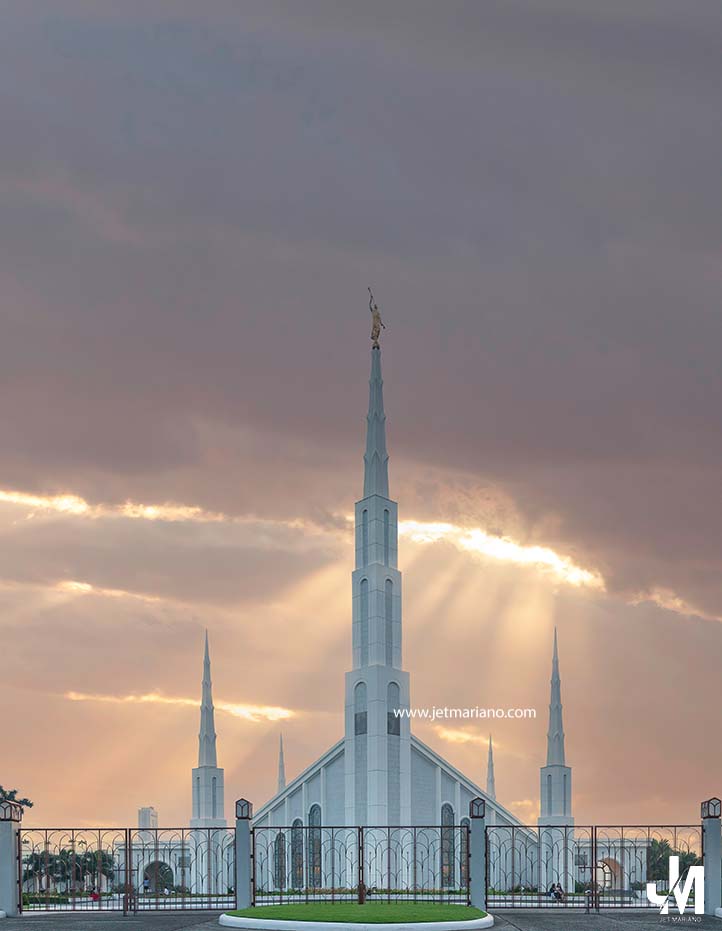
Manila woke to a sky of soft fire, and the spires answered. The world often mistakes meekness for weakness, but heaven doesn’t. Meekness is how we hear the ‘still, small voice’ in a loud century, how we keep working without being seen, how we forgive when no one claps. In that quiet courage, the Lord gives what He promised—rest for the soul and light for the road.
Excerpt
Meekness isn’t weakness—it’s the enabling power to wear Christ’s yoke, learn of Him, and endure well. It quiets pride, softens intellect, and turns stumbling blocks into stepping stones.
Intro
Today I revisited Elder Neal A. Maxwell’s 1986 devotional, “Meek and Lowly.” The world treats meekness as quaint; heaven calls it essential: “For none is acceptable before God, save the meek and lowly in heart” (Moroni 7:44). Jesus invites, “Take my yoke upon you, and learn of me; for I am meek and lowly” (Matthew 11:29). Meekness is the key that makes discipleship possible—steady work, quiet strength, and “thanksgiving daily” even in stern seasons.
Straight line
Wear His yoke, learn of Him. Meekness is how disciples are taught by the Yoke-Master—an education for mortality and eternity.
Do good—and don’t weary. Maxwell stacks the stretch: do good and don’t faint; endure and endure well; forgive and forgive “seventy times seven.”
Drop the heavy baggage. Meekness sheds fatiguing insincerity, hunger for praise, and the “strength-sapping quest for recognition.”
Meekness deepens discipleship. God gives challenges to keep us humble (Ether 12:27). Meekness steadies us when misrepresented or misunderstood.
One missing virtue matters. Like the rich young ruler, other strengths can’t compensate for missing meekness—it alters decisions and destiny.
A friend of true education. “Humbleness of mind” opens us to things we “never had supposed” (Moses 1:10); without it we’re “ever learning” yet missing truth (2 Tim. 3:7).
Pride is in all our sins. Meekness breaks those polished chains—resentment, offense-hunting, murmuring, and small, myopic views of reality.
Ears to hear. The meek listen long enough to recognize the Shepherd’s voice and turn “rocks of offense” into stepping stones.
Grace flows to the meek. “His grace is sufficient” (Ether 12:26). Without meekness there is no sustained faith, hope, or charity (Moroni 7:43–44).
Line upon line. Meekness partners with patience—time to absorb, repent, and be made strong in weak places (Ether 12:27; 2 Nephi 28:30).
Final reflection
Meekness is not passivity; it’s power under covenant. It lets Christ carry the kingdom while we do our duty, turns offense into learning, and keeps us rejoicing when no one’s clapping. If I would know the Lord better, I must wear His yoke longer.
Pocket I’m keeping
Wear His yoke → learn of Him
Do good and don’t weary
Shed praise-hunger; drop old grievances
Listen longer; recognize His voice
Ask “rightly,” wait “line upon line”
Let grace make weak things strong
What I hear now
“Take my yoke upon you, and learn of me… and ye shall find rest unto your souls.” (Matthew 11:29)
The flight was rough, the miles were many, but the morning at the temple was calm and sure.
Excerpt Discouragement isn’t in the trouble; it’s the adversary’s germ. The cure: prepare, work early, repent quickly, and remember angels round about us.
Intro Today I revisited Elder Jeffrey R. Holland’s 1980 devotional, “For Times of Trouble.” Trouble is universal; discouragement is a germ the adversary wants inside us. The scriptures teach that “preparation—prevention if you will—is perhaps the major weapon in your arsenal against discouragement and self-defeat.” I’m choosing preparation and steady work over panic and self-doubt.
Straight line
Prepare early. “The time to repair the roof is when the sun is shining… If ye are prepared ye shall not fear.”
Live simply and gratefully. “Love your life, poor as it is. …The setting sun is reflected from the windows of the almshouse as brightly as from the rich man’s abode.” (Thoreau, Walden)
Do the work. “Prepare. Plan. Work. Sacrifice. Rework. Spend cheerfully on matters of worth.” Start early; finish calmly.
Learn from setbacks. “Love your life, poor as it is. Drive even these experiences into the corner… and learn from them.” Trials can forge timeless bonds with saints who walked the same road.
Repent quickly. Change now and prove it daily. “You can change anything you want to change, and you can do it very fast.”
Remember help from both sides of the veil. “They that be with us are more than they that be with them.” Angels stand round about us.
Final reflection My part is preparation, planning, and cheerful sacrifice. God’s part is grace, change, and ministering angels. I will work early, repent quickly, and let heaven handle what I cannot.
Pocket I’m keeping
Prepare early; prevent discouragement
Love my life—simple, grateful, steady
Work → rework → finish calmly
Learn from pain; keep bonds with the faithful
Change fast, then prove it
Angels round about
What I hear now “Sanctify yourselves: for tomorrow the Lord will do wonders among you.” (Joshua 3:5)
San Diego California Temple — made on an early iPhone. Daylight reminds me it’s less about the lens and more about the eye and the feeling. This house is family to me—my firstborn was sealed here on 12/12/12 at 12:00 PM.
Excerpt President Thomas S. Monson teaches that joy is not in the distant future but in the daily moments we cherish with gratitude and love.
Intro Life changes—sometimes suddenly, often gradually. President Thomas S. Monson reminds us that we cannot pile up tomorrows and expect joy to wait. Joy is in the journey now—in gratitude, in kindness, in cherishing those around us before it is too late.
Straight line (what he’s saying) • Change is constant; the key is learning what matters most. • Childhood, family time, and simple daily joys vanish if we postpone them. • Don’t wait for tomorrows that never come; love must be shown today. • Never let a problem to be solved become more important than a person to be loved. • Gratitude transforms lack into abundance; ingratitude blinds us to God’s gifts. • Challenges will come, but we choose whether to cherish or neglect the people we love. • Christ’s example—serving, forgiving, and loving to the end—shows us how to live joyfully.
Final reflection Time never stands still. My regrets are not about things I did, but things I left undone—words unsaid, kindness unshown. President Monson’s reminder echoes: joy is not about someday; it is about today.
Pocket I’m keeping • Hug my family more, speak my love more. • Write the note, send the message, make the call—today. • Guard against letting stress eclipse people. • Give thanks deliberately, even for the small, ordinary blessings. • Joy = gratitude in motion.
What I hear now Joy is a daily decision, not a future destination. If I train my heart to see God’s gifts in every moment, life itself becomes the journey worth rejoicing in.
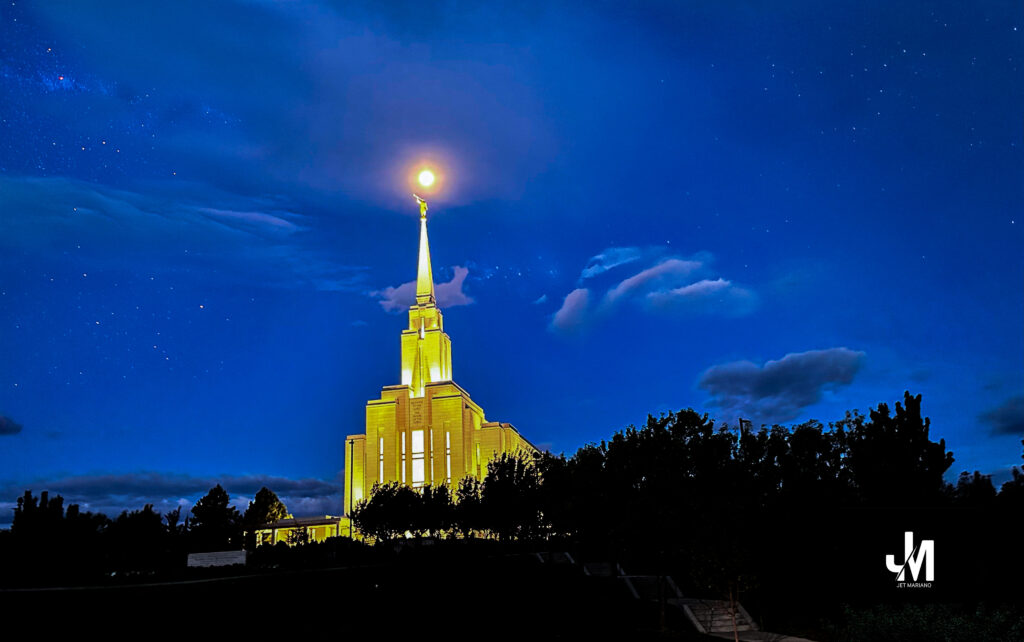
Waning gibbous, waiting: I timed the moon to rest behind the Angel Moroni atop the Oquirrh Mountain Temple—quiet light on a higher call.
Excerpt Selfishness is not just a flaw—it’s self-destruction in slow motion. Elder Neal A. Maxwell teaches that meekness is the real cure, for it doesn’t just mask selfishness but dissolves it.
Intro Joseph Smith urged that selfishness be “not only buried, but annihilated.” Elder Maxwell builds on that: selfishness shrinks the soul, corrodes society, and detonates commandments. Like Copernicus reminding the world it wasn’t the center of the universe, we too must learn—we are not the center. Meekness and unselfish discipleship are the only antidotes.
Straight line (what he’s saying) • Selfishness = self-destruction in slow motion. It narrows life until others no longer matter. • Appetite and ego can never fill emptiness; zero multiplied by anything is still zero. • Selfishness masks itself as swagger but is as provincial as goldfish in a bowl. • Joseph Smith: selfish feelings must be annihilated, not moderated. • Common forms: puffing credit, resenting others’ success, withholding kindness, rudeness, and abuse. • Cultural consequence: when selfishness spreads, societies decline—without mercy, without love, past feeling. • Selfishness detonates the Ten Commandments: it fuels envy, adultery, dishonesty, even murder. • Cain’s “I am free” after slaying Abel = ultimate selfish blindness. • Today: people strain at gnats (small issues) while swallowing camels (grave sins like abortion). • Followers share accountability with leaders in cultural decline; excuses won’t save. • True freedom comes from unselfishness—serving, forgiving, and lifting others. • Christ Himself is the supreme contrast: He did not look out for “number one.”
Final reflection Selfishness corrodes both heart and culture. The cure is meekness—choosing to notice, to yield, to bless. When I dissolve selfish wants, space opens for Christlike love. The world says “look out for number one”; Jesus says, “lose yourself and you’ll find life.”
Pocket I’m keeping • Before big actions: quietly ask, “Whose needs am I meeting?” • Practice daily meekness: count to 10 before speaking, let the Spirit filter words. • Replace envy with gratitude; bless the success of others. • Sow unselfishness in family life—ordinary duties cultivate extraordinary love. • Remember: selfishness shrinks, meekness expands.
What I hear now Unselfishness frees me under a “freer sky,” as Chesterton said. Meekness is not weakness—it’s strength without selfishness. When I choose it, selfishness dissolves and discipleship deepens.
When you need to quickly spin up a test or lab machine, cloning an existing VM can save hours compared to building from scratch. VMware PowerCLI brings the full power of vSphere management into PowerShell. Here’s a simple walkthrough.
Pick the source VM, target VM names, host, and datastore. Example:
# Define source VM
$sourceVM = "Base-Win10-VM"

# Clone to new VM
New-VM -Name "Test-VM01" -VM $sourceVM `
       -VMHost (Get-VMHost -Name <target-host>) `
       -Datastore (Get-Datastore -Name <datastore-name>) `
       -Location (Get-Folder -Name "VMs")
-VM points to the existing machine you’re cloning.
-VMHost pins the new VM to a specific ESXi host.
-Datastore chooses where to store the VM’s disks.
-Location defines the vCenter folder for organization.
Step 4 — Power On the New VM
Start-VM -VM "Test-VM01"
Final Reflection
PowerCLI makes cloning fast, repeatable, and scriptable. Instead of clicking through vSphere UI screens, you can prepare test VMs with a single command.
Super Blood Moon over the Los Angeles California Temple — not visible in America last night, so I pulled this in-camera Nikon double exposure from my archives (Oct 2014). Thinking celestial means taking the long view: steps, stars, and a witness in the heavens.
Excerpt President Nelson invites us to “think celestial”—to take the long, eternal view where today’s choices shape forever.
Intro President Russell M. Nelson taught that God’s plan is “fabulous,” that our choices matter eternally, and that the Savior’s Atonement makes that plan possible. His invitation: adopt the practice of “thinking celestial.”
Straight line (what he’s saying) • “The baseless notion that we should ‘eat, drink, and be merry …’ is one of the most absurd lies in the universe.” • “I invite you to adopt the practice of ‘thinking celestial’! … ‘to be spiritually-minded is life eternal.’” • “Mortality is a master class” in choosing what matters most. “Your choices today will determine … where you will live throughout all eternity, the kind of body … [and] those with whom you will live forever.” • “Only men and women who are sealed … in the temple, and who keep their covenants, will be together throughout the eternities.” • If we choose telestial laws now, we choose a telestial glory then. • “How and where and with whom do you want to live forever? You get to choose.” • “Take the long view—an eternal view. Put Jesus Christ first … your eternal life is dependent upon your faith in Him and in His Atonement.” • “When you are confronted with a dilemma, think celestial! … When the pressures of life crowd in upon you, think celestial!”
Final reflection Thinking celestial reframes today: my calendar becomes covenant practice, my setbacks become schooling, and my worship becomes preparation for where—and with whom—I want to live forever.
Pocket I’m keeping • Begin with the end in mind (celestial family). • Choose temple time and covenant keeping first. • Guard agency—avoid anything that becomes a “god.” • Pray beyond a shopping list; seek revelation. • Take the long view when hurt, hurried, or tempted.
What I hear now Tonight I’m posting an archival blood-moon shot and taking the eternal view. The moon changes phase; covenants point to permanence. Think celestial.
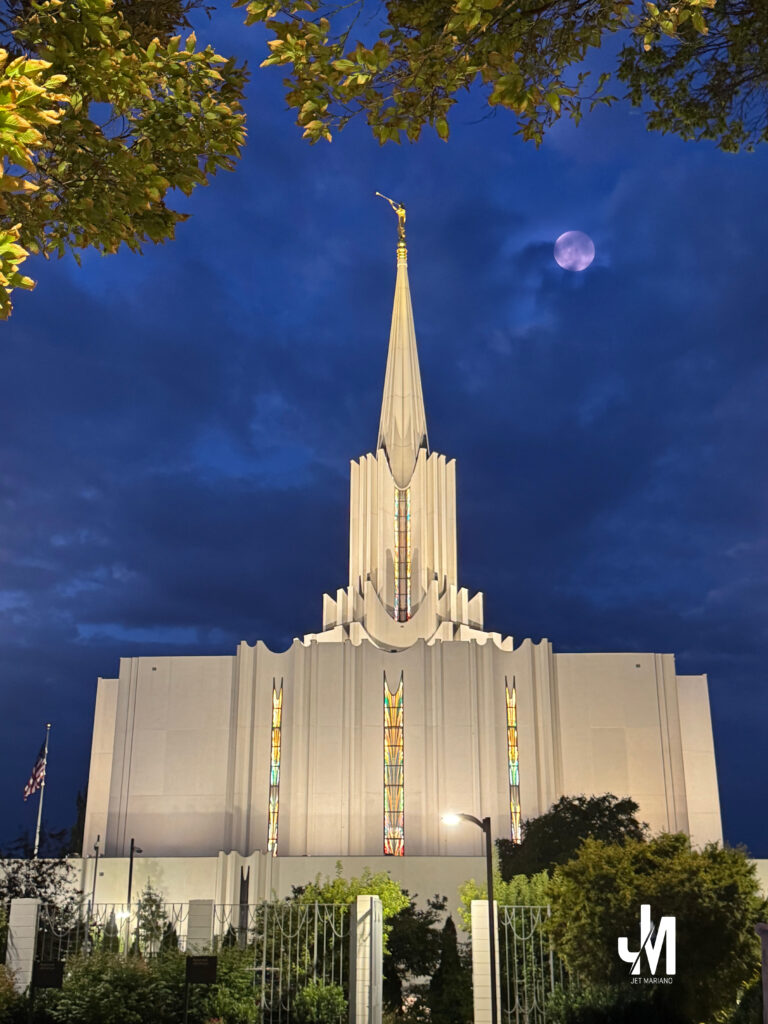
Waxing gibbous moon peeking through stormy blue over the Jordan River Utah Temple, Friday night (9/5/25), framed by leaves and looking East South East of the sky.
lle’s “preconditioning,” included the Power of Now reference, and linked the YouTube clip you gave me:
Excerpt Desire steers destiny. Elder Neal A. Maxwell teaches that God judges “according to the desire of [our] hearts”—and helps us train those desires toward Him.
Intro Maxwell reframes agency at its core: desires are the drivers. Genes, circumstances, and environments matter, but—as he reminds us—“there remains an inner zone in which we are sovereign, unless we abdicate.” In that sacred space lies our real agency.
Eckhart Tolle explains the other side of the equation in what he calls preconditioning:
“Mental and emotional filters: our minds are filled with ingrained narratives, beliefs, and emotional patterns that act like lenses through which we view the world.”
Those filters shape perception, just as culture, family patterns, and past wounds bend behavior. Yet, as Maxwell insists, they cannot erase that sovereign inner zone. What we persistently desire is who we become—and what we receive.
Straight line (what he’s saying) • Desire is more than preference; it’s a real longing that directs agency and outcomes. • God mercifully considers our desires, works, and degrees of difficulty—yet won’t force us. • Satan desires our misery; wrong desires make us our own victims. • Lukewarmness flattens the soul; righteous desires must be relentless, daily. • Education of desire = learn truth and learn to love it; small acts create spiritual momentum. • “Do you,” President Brigham Young asked, “think that people will obey the truth because it is true, unless they love it? No, they will not” (Journal of Discourses, 7:55). • Some desires must dissolve (envy, self-pity); weak righteous desires can grow strong. • Parents teach and model, but each soul must choose; God’s arm is stretched out still. • In process of time, holy desires produce holy works. • Preconditioning may set the stage—but the sovereign inner zone decides the play.
Final reflection My outcomes track my appetites. When I aim my wants at ease or applause, I drift. When I aim them at Jesus, momentum returns. Desire is today’s steering wheel. Elder Maxwell’s reminder of the inner zone keeps me accountable: I can’t blame culture, genes, or preconditioning. They explain, but they don’t excuse. Tolle helps me name the filters that fog my lens, but Maxwell reminds me that God still waits on what I choose to desire.
Pocket I’m keeping • Pray, then plan by desire: “More holiness give me” → schedule one aligned act. • Replace envy with intercession: bless the person I’d be tempted to compare with. • Feed the flame daily—scripture, sacrament, service—before screens. • Name one mis-aimed desire and starve it for a week. • Measure progress by direction and devotion, not dopamine.
What I hear now If I train my want-to, God will shape my able-to. Even a spark—“I desire to believe”—is enough for Him to begin multiplying light.
Excerpt Our all-hands list rejected internal senders after we allowed two external addresses. Here’s what happened, how to fix it cleanly in Exchange Online, and a PowerShell snippet you can reuse.
Intro Two days ago, I could email everyone@[redacted].com just fine. Today, my message bounced: “this group only accepts messages from people in its organization or on its allowed senders list.” We’d recently added two partner addresses (s@[partner].com, j@[partner].com) so they could email the DL. That change flipped the DL into strict allow-list mode—blocking even internal senders who weren’t explicitly listed. Here’s the minimal, durable fix.
Straight line (what happened) • Symptom: NDR when sending to everyone@[redacted].com from an internal account. • State check showed: – RequireSenderAuthenticationEnabled: False – AcceptMessagesOnlyFromSendersOrMembers: {} (and earlier, it contained only the two partner GUIDs). • Root cause: Delivery management was saved in “only these senders” mode; membership/ownership doesn’t matter in that state. • Goal: Let all internal, authenticated users send; allow only specific externals; block the rest.
Fix (clean model)
Let internal, authenticated users send to the DL (no hard allow-list on the group).
Enforce external restrictions with a transport rule that allows only the partner exceptions.
Commands (PowerShell — Exchange Online)
Connect
Connect-ExchangeOnline -ShowBanner:$false
Allow internal, authenticated senders (clear hard allow-list)
# add another partner
Set-TransportRule "Block external to Everyone (except allow-list)" `
  -ExceptIfFrom @{Add="newuser@[partner].com"}

# remove a partner
Set-TransportRule "Block external to Everyone (except allow-list)" `
  -ExceptIfFrom @{Remove="j@[partner].com"}
Smoke tests • Internal sender → everyone@[redacted].com: delivers. • External sender (not on list): NDR with “External senders are not allowed…” • Allowed partner (s@[partner].com or j@[partner].com): delivers.
Why not leave the DL in allow-list mode? Because it’s brittle. Every internal sender must be explicitly added, which guarantees future bounces and admin toil. Using RequireSenderAuthenticationEnabled for internal mail + a transport rule for externals gives you clarity and control.
Final reflection Small toggles can have outsized effects. DL delivery settings look simple, but one checkbox can silently change who’s “allowed.” The durable pattern is: authenticate inside, whitelist outside, and verify with a quick trace.
Pocket I’m keeping • Always snapshot DL settings before/after a change. • Prefer transport rules for external policy; don’t hard-gate internals via allow-lists. • Add a ready-to-run “add/remove external exception” snippet to the runbook.
What I hear now Clarity beats cleverness. Make the rule obvious enough that the next admin can read it and know exactly who can send and why.